
📚 Table of Contents
Part 1: The Physical Cost of Artificial Intelligence: Inside the Data Centres Powering Our Future
Artificial intelligence is becoming more normal nowadays. We interact with ChatGPT, ask Google to summarize search results, stream movies on Netflix, or store files in the cloud without ever considering where those services actually exist.
The internet has trained us to think of digital technology as something intangible, floating somewhere in “the cloud.” In reality, the cloud is anything but invisible. Behind every AI-generated answer, online purchase, streamed video, and business application are vast industrial facilities filled with computers that operate around the clock.
The rapid rise of generative AI has transformed these facilities from a relatively niche part of the technology industry into one of the world’s fastest-growing infrastructure sectors. Companies such as Microsoft, Google, Amazon, Meta, OpenAI, Oracle, and xAI are investing hundreds of billions of dollars in new computing infrastructure to support increasingly powerful artificial intelligence models. According to the International Energy Agency (IEA), the global expansion of AI is expected to become one of the largest drivers of electricity demand over the coming decade, placing unprecedented pressure on energy grids, water supplies, and local communities.
At the same time, communities across the United States and other countries are beginning to ask difficult questions. While these facilities create jobs and stimulate local investment, they also consume enormous amounts of electricity, water, and land. Residents living near major developments have raised concerns about noise, pollution, pressure on public infrastructure, and competition for local water resources. What was once viewed as ordinary digital infrastructure has become an increasingly controversial topic in public policy and environmental planning.
Understanding this debate begins with understanding what a data centre actually is.
Part 2: Inside an AI Data Centre
At its simplest, a data centre is a highly secure building that houses thousands, and sometimes hundreds of thousands, of computers called servers. These servers store information, process data, and deliver digital services to users across the world. Every time you upload a photograph, make a video call, stream music, send an email, or use an AI assistant, your request is processed by one or more servers inside a data centre.
Unlike the desktop computer sitting in a home office, servers are designed to operate continuously. They run 24 hours a day, seven days a week, often for years without interruption. Because businesses, hospitals, financial institutions, airlines, governments, and emergency services all rely on these systems, downtime is extremely expensive. A single outage can affect millions of users and cost companies millions of dollars.
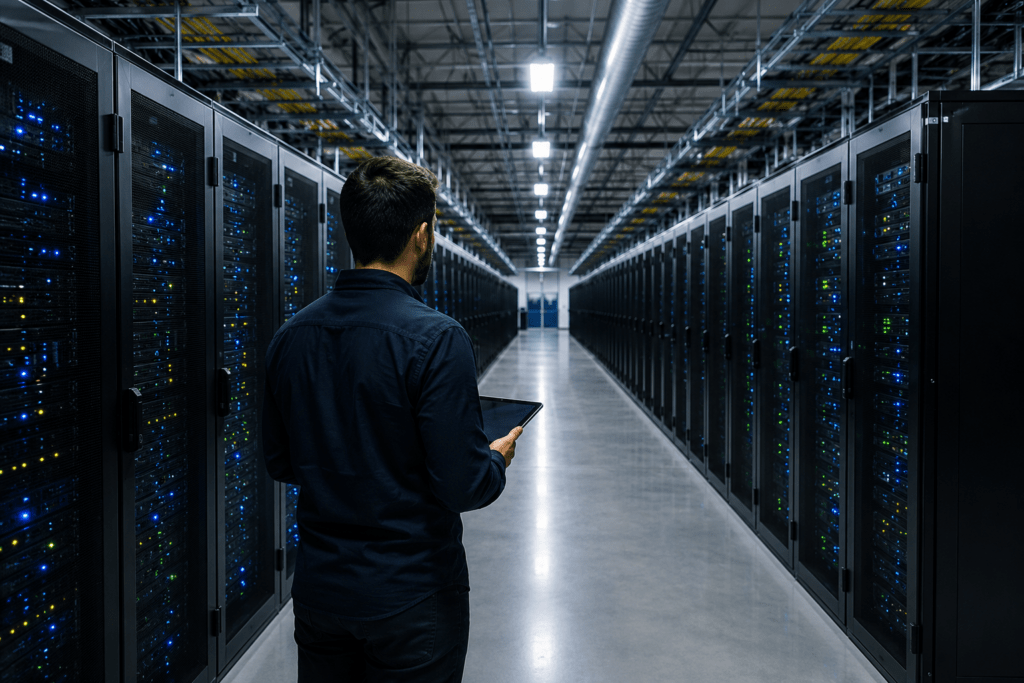
Inside a modern data centre, servers are arranged in long rows of metal cabinets known as racks. Each rack contains multiple servers connected by ultra-fast networking equipment that allows information to move almost instantly between machines. Massive storage systems hold everything from family photos to banking records, while sophisticated networking hardware connects the facility to fibre optic internet infrastructure spanning entire continents.
Power reliability is equally critical. Data centres cannot simply switch off if the local electricity supply fails. For that reason, most facilities include multiple redundant power feeds, enormous battery backup systems known as UPS (Uninterruptible Power Supplies), and diesel or natural gas generators capable of supplying electricity during prolonged outages. Many larger facilities are engineered so that if one power source fails, another takes over within milliseconds, preventing any interruption to services.
Security extends far beyond cybersecurity. Access to server rooms is tightly controlled through biometric scanners, security checkpoints, surveillance cameras, and multiple layers of physical protection. Fire suppression systems are specially designed to extinguish fires without damaging sensitive electronics, while environmental monitoring systems continuously measure temperature, humidity, airflow, and power consumption throughout the building.
For decades, this model served businesses, governments, and internet services remarkably well. However, artificial intelligence has fundamentally changed what these facilities need to do.
Why AI Data Centres Are Different
Traditional data centres were primarily designed to store information and process relatively predictable workloads such as websites, databases, financial transactions, or business software. AI workloads are fundamentally different.
Training a modern large language model involves processing trillions of mathematical calculations across enormous datasets. Instead of relying mainly on conventional computer processors, AI systems depend on Graphics Processing Units, better known as GPUs. Originally developed to render video games, GPUs excel at performing thousands of calculations simultaneously, making them ideal for machine learning and neural network training.
This shift has transformed the design of modern data centres. AI facilities contain densely packed GPU clusters connected by ultra-high-speed networking, allowing tens of thousands of processors to work together as if they were one enormous computer. These clusters require dramatically more electricity than conventional server rooms. While a traditional server rack may consume between 5 and 10 kilowatts of power, AI racks can exceed 60 kilowatts, with some next-generation systems requiring even more.
The scale of investment reflects this technological shift. Industry estimates suggest that major technology companies could collectively spend around $650 billion on AI infrastructure during 2026 alone, illustrating how central these facilities have become to the global AI race.
But greater computing power comes with greater physical demands:
- Every additional processor generates heat.
- Every rack requires electricity.
- Every cooling system consumes resources.
As AI models become larger and more sophisticated, the infrastructure supporting them grows larger as well, raising an important question: If AI exists in the digital world, why does it consume so many real-world resources?
Part 3: The Hidden Cost of AI: Electricity, Water and the Resources Behind Every Prompt
For most people, using artificial intelligence lasts only a few seconds. A question is typed into ChatGPT, an image is generated, or a search engine produces an instant answer. The experience feels effortless, creating the impression that AI exists in a purely digital space. In reality, every interaction depends on an immense physical infrastructure consuming electricity, water, land, and raw materials on a scale that few users ever see.
As AI models become larger and more capable, the infrastructure supporting them must expand accordingly. This growth has sparked a global debate about whether the benefits of AI outweigh its environmental costs, particularly as governments and technology companies race to build increasingly powerful data centres.
Why AI Requires So Much Electricity
Artificial intelligence is fundamentally a computational problem. Every time an AI model is trained or generates a response, billions or even trillions of mathematical calculations are performed. Unlike traditional software, which follows predefined instructions, AI models repeatedly process enormous datasets to recognise patterns, improve predictions, and generate new content.
Training one of today’s frontier AI models can take weeks or months using tens of thousands of GPUs operating simultaneously. Even after training is complete, those models continue consuming significant energy every time users interact with them. This stage, known as AI inference, has become one of the fastest-growing sources of computing demand as millions of people use AI-powered applications every day.
The International Energy Agency (IEA) estimates that electricity demand from data centres is set to increase dramatically over the coming decade, driven largely by artificial intelligence. In many countries, AI infrastructure is expected to become one of the fastest-growing sources of electricity consumption, creating new challenges for energy grids already under pressure from population growth, electrification, and renewable energy transitions.
The agency projects that global electricity demand from data centres could more than double by 2030, with AI accounting for a substantial share of that increase. While improvements in chip efficiency continue to reduce the amount of energy required for individual calculations, those gains are being outpaced by the rapid growth in AI workloads and the construction of increasingly larger computing clusters.
This growing demand has prompted utilities around the world to accelerate investments in power generation and transmission infrastructure. In some regions, entirely new substations and transmission lines are being built primarily to support planned AI campuses.
The Water Behind the Cloud
Electricity is only part of the story.
Every watt of electricity consumed by a processor eventually becomes heat. Without effective cooling, server temperatures would quickly rise beyond safe operating limits, leading to equipment failures and system shutdowns. Managing this heat has become one of the greatest engineering challenges facing the AI industry.
Many people assume that cooling simply involves large air conditioning systems. While air cooling remains important, many large data centres also depend on water.
One of the most common approaches uses evaporative cooling towers. Warm water absorbs heat from servers before being pumped to cooling towers, where a portion of the water evaporates into the atmosphere. This evaporation removes heat very efficiently, allowing cooler water to circulate back into the system.
The process is highly effective, but it comes at a cost. Unlike closed plumbing systems inside homes, evaporated water cannot be recovered. Fresh water must continually replace what has been lost, creating substantial demand on local water supplies.
According to research highlighted by the Lincoln Institute of Land Policy, large data centres can consume millions of gallons of water every day depending on their size, climate, and cooling technology. Facilities located in hotter regions generally require even more cooling because outdoor temperatures reduce the efficiency of heat removal.
Water is also consumed indirectly through electricity generation. Thermal power stations, including natural gas, coal, and nuclear plants, often require significant volumes of water for cooling. As a result, the true water footprint of AI extends beyond the data centre itself and includes the resources needed to produce its electricity.
Researchers sometimes distinguish between direct water consumption, which occurs inside the facility, and indirect water consumption, which results from energy production. Together, these two forms of water use create a much larger environmental footprint than many people realise.
Cooling Technologies Are Rapidly Evolving
The extraordinary heat produced by modern AI processors has forced engineers to rethink traditional cooling methods.
For many years, cold air was sufficient to keep servers within safe operating temperatures. Powerful fans pushed chilled air through server racks while hot air was extracted and cooled before being recirculated. This approach worked well for conventional computing workloads but has become increasingly difficult as AI hardware consumes far more power within the same physical space.
The industry is now shifting toward liquid cooling technologies.
One increasingly common approach involves circulating coolant directly through cold plates attached to processors. Liquids transfer heat much more efficiently than air, allowing GPUs to operate at higher performance while reducing the energy required for cooling.
Some experimental systems go even further by immersing entire servers in specially engineered dielectric fluids that do not conduct electricity. These immersion cooling systems remove heat exceptionally efficiently while reducing the need for large air conditioning systems.
Although liquid cooling can improve energy efficiency, it does not automatically eliminate water consumption. Different technologies have different environmental trade-offs, and many facilities continue using combinations of air cooling, liquid cooling, and evaporative systems depending on local climate and operational requirements.
Technology companies are investing heavily in these innovations because cooling now represents one of the largest operational costs associated with AI infrastructure.
Beyond Electricity and Water
The environmental footprint of AI extends well beyond energy and cooling.
Building a hyperscale AI data centre requires enormous quantities of steel, concrete, aluminium, copper, rare earth elements, semiconductors, fibre-optic cables, batteries, transformers, and backup power systems. Manufacturing these materials carries its own environmental impacts, including mining, transportation, and industrial emissions.
Construction itself often transforms hundreds of acres of land into industrial campuses containing multiple data halls, substations, cooling equipment, parking areas, and security infrastructure. In rapidly growing technology regions, demand for suitable land has intensified competition with housing, agriculture, and other forms of development.
These facilities also require constant deliveries of replacement equipment throughout their operational life. Servers are regularly upgraded as newer, more efficient hardware becomes available, creating an ongoing cycle of manufacturing, logistics, and electronic waste management.
Many technology companies have established recycling programmes to recover valuable materials from retired equipment, but the pace of AI development means hardware replacement cycles are becoming increasingly frequent.
Is AI Worth the Environmental Cost?
The growing resource demands of AI have led to an important question: should society accept these environmental costs in exchange for the benefits that artificial intelligence provides?
Supporters argue that AI has the potential to accelerate medical research, improve scientific discovery, optimise electricity grids, increase manufacturing efficiency, and even help address climate change by improving resource management. From this perspective, the energy consumed by AI represents an investment in technologies that could ultimately reduce emissions across many sectors of the economy.
Critics, however, argue that the pace of infrastructure development is outstripping public discussion about its long-term consequences. They question whether communities should bear increased pressure on water supplies, electricity grids, and local infrastructure to support rapidly expanding AI services whose benefits are often distributed globally rather than locally.
This debate becomes even more complex when data centres are built close to residential neighbourhoods.
For the people living nearby, the discussion is no longer about abstract computing power or technological progress. It becomes a question of everyday life: access to water, constant noise from cooling equipment, changing landscapes, rising demand for housing, and concerns about how these massive industrial facilities may reshape their communities.
Part 4: When the Cloud Moves Next Door: How AI Data Centres Are Changing Local Communities
Artificial intelligence is often discussed as a global technology, but its impacts are deeply local. While companies announce new AI models and billion-dollar investments from corporate headquarters, the physical infrastructure supporting those systems is being built in towns, suburbs, and rural communities around the world.
For residents living near these developments, the conversation is no longer about technological innovation or economic competitiveness. It is about whether there will be enough water during dry seasons, whether electricity prices will rise, whether farmland will disappear beneath industrial buildings, and whether the promise of new jobs justifies the changes taking place in their neighbourhoods.
As governments compete to attract investment from technology companies, local communities increasingly find themselves balancing economic opportunity against environmental and quality-of-life concerns.
Why Data Centres Are Built Where People Live
Modern data centres cannot be built just anywhere.
Developers look for locations with reliable electricity, access to high-capacity fibre-optic networks, available land, stable geology, and proximity to major population centres. Many facilities are also located near renewable energy projects or existing power infrastructure capable of supporting extremely high electrical loads.
These requirements often place new developments close to existing communities. In many cases, local governments welcome these projects because they promise investment, tax revenue, and employment. Construction alone can generate hundreds or even thousands of temporary jobs, while completed facilities create permanent positions for engineers, technicians, electricians, security staff, and maintenance teams.
Large technology companies also argue that data centres attract additional investment by encouraging suppliers, telecommunications providers, and supporting industries to establish operations nearby. Yet many residents question whether these benefits outweigh the long-term impacts.
Unlike manufacturing plants, data centres employ relatively small workforces once construction is complete. A billion-dollar facility occupying hundreds of acres may create only a few dozen or a few hundred permanent jobs, leading some communities to ask whether the land and infrastructure could have supported developments generating broader economic benefits.
Water: A Growing Source of Concern
Among all the environmental issues surrounding AI infrastructure, water has become one of the most contentious.
Many hyperscale data centres require significant volumes of water for cooling, particularly during periods of high temperatures. While exact consumption varies depending on climate, cooling technology, and operational demands, the cumulative effect can place considerable pressure on local water systems, especially in regions already vulnerable to drought.
Researchers at the Lincoln Institute of Land Policy note that water consumption is becoming one of the defining planning challenges associated with modern data centres. In some communities, concerns extend beyond the amount of water being used to questions about who receives priority access when supplies become limited.
In areas where agriculture, households, and industry already compete for finite water resources, the arrival of a major AI campus can intensify existing tensions. Residents often ask whether long-term water planning has adequately considered future population growth alongside expanding digital infrastructure.
Technology companies respond that many newer facilities recycle water, use treated wastewater where available, and continue investing in more efficient cooling technologies. Several major operators have also committed to becoming “water positive,” meaning they aim to replenish more water than they consume through conservation and restoration projects.
Critics, however, argue that these commitments vary between companies and locations, while the immediate demands placed on local water systems remain very real.
More Than Water: Noise, Traffic and Air Quality
Large AI data centres operate continuously, twenty-four hours a day, throughout the year. Keeping thousands of servers cool requires powerful fans, pumps, chillers, and cooling towers that generate constant background noise.
Although operators are required to comply with environmental regulations and local noise limits, residents living close to facilities sometimes report a persistent low-frequency hum, particularly during the night when surrounding neighbourhoods are quieter.
Construction itself can last several years, bringing increased traffic, heavy machinery, dust, and disruption to nearby roads. Once operational, the facilities require fewer daily deliveries than warehouses or manufacturing plants, but backup fuel systems, maintenance vehicles, and periodic equipment replacements continue generating industrial activity.
Air quality concerns also arise from emergency power systems.
Most data centres maintain large diesel generators capable of supplying electricity during prolonged power failures. These generators are rarely used during normal operations, but they are tested regularly and may operate during emergencies. Environmental groups argue that increasing numbers of backup generators could contribute to local air pollution if used frequently, particularly as AI infrastructure expands.
Industry representatives counter that generator testing is carefully regulated and that many companies are exploring cleaner alternatives, including battery storage, renewable energy integration, hydrogen technologies, and natural gas systems with lower emissions.
The Politics of AI Infrastructure
As more AI campuses are proposed, local planning meetings have become increasingly contentious. Residents have raised concerns about transparency, environmental reviews, electricity demand, and whether local communities have sufficient influence over developments that may permanently reshape their surroundings. These concerns recently expanded beyond individual towns.
In July 2026, coordinated protests against data centre expansion took place across 42 U.S. states, marking the first nationwide movement focused specifically on AI infrastructure. Demonstrators expressed concerns over water consumption, electricity demand, environmental impacts, and the pace of development, while organisers argued that communities deserved greater involvement in planning decisions.
The protests reflected something unusual in modern politics.
Opposition to large AI data centres has attracted support from people across the political spectrum. While motivations differ, environmental concerns, local decision-making, public resource management, and questions about the economic benefits of AI infrastructure have created an issue that transcends traditional political divisions. Reuters reported that a recent Reuters/Ipsos poll found relatively limited public support for large data centres being built within respondents’ own communities.
Governments are beginning to respond.
Several jurisdictions around the world have introduced stricter planning rules, temporary moratoriums, or new environmental requirements for future data centre developments. Policymakers increasingly recognise that AI infrastructure is no longer simply a technology issue but one involving energy policy, water management, urban planning, and environmental sustainability.
Balancing Global Benefits with Local Costs
Few people dispute that artificial intelligence is becoming an increasingly important part of modern life. AI is already accelerating medical research, supporting scientific discovery, improving logistics, and helping businesses operate more efficiently. These advances depend on powerful computing infrastructure, making data centres an essential part of the digital economy.
Communities hosting these facilities often bear the environmental and infrastructural impacts, while the digital services they enable benefit millions of users spread across the world. That imbalance has become one of the central questions facing policymakers, technology companies, and local governments.
Finding the right balance will require more than engineering solutions. It will depend on transparent planning, responsible resource management, meaningful public engagement, and continued investment in technologies that reduce environmental impacts without slowing innovation.
Part 5: The People Behind the Infrastructure and the Debate Shaping AI’s Future
When people imagine a data centre, they often picture a vast building filled with blinking lights and endless rows of servers operating without human involvement. While automation plays a crucial role in modern facilities, AI data centres remain highly dependent on skilled professionals. Behind every AI model, cloud application, and digital service is a workforce responsible for maintaining one of the most complex pieces of infrastructure ever built.
Unlike traditional office environments, data centres never close. Engineers, technicians, security teams, and operations specialists work around the clock to ensure that thousands of interconnected systems continue functioning without interruption. Even a brief outage can disrupt businesses, financial institutions, hospitals, emergency services, and millions of everyday users who rely on cloud computing.
A Workplace Built Around Reliability
Running an AI data centre is far more than installing servers and switching them on. Every day involves continuous monitoring, preventive maintenance, hardware upgrades, and responding to unexpected issues before they become serious problems.
Technicians regularly replace failed components, install new GPU servers, inspect fibre-optic connections, and verify that equipment is performing within strict operational limits. Every repair must be carried out carefully because neighbouring systems often continue operating while maintenance takes place.
Electrical engineers oversee substations, transformers, battery backup systems, and emergency generators. Their work is focused on ensuring that electricity remains stable regardless of external conditions. If a power disruption occurs, backup systems must activate within milliseconds to avoid interrupting AI workloads that may have been running continuously for weeks.
Mechanical engineers concentrate on cooling infrastructure. As AI hardware becomes more powerful, maintaining safe operating temperatures has become one of the industry’s greatest technical challenges. Pumps, chillers, heat exchangers, liquid cooling loops, and ventilation systems require constant inspection and optimisation to prevent overheating while reducing energy and water consumption.
Many facilities also employ network engineers, cybersecurity specialists, facilities managers, logistics coordinators, environmental compliance officers, and physical security personnel. Although AI itself is designed to automate many digital tasks, the infrastructure supporting it still relies heavily on human judgement, experience, and rapid decision-making.
Monitoring Thousands of Systems at Once
Modern AI data centres generate enormous amounts of operational data.
Thousands of sensors continuously measure temperatures, humidity, airflow, electrical loads, water usage, equipment vibration, network performance, and hardware health. Much of this information is displayed in Network Operations Centres (NOCs), where teams monitor the facility twenty-four hours a day.
Artificial intelligence is increasingly being used to manage this infrastructure as well. Machine learning systems can analyse equipment behaviour, identify unusual patterns, and predict when components are likely to fail before any visible problems appear. This approach, known as predictive maintenance, helps reduce downtime while allowing engineers to replace equipment before it reaches the end of its operational life.
Automation can also optimise cooling systems by adjusting airflow, pump speeds, and cooling capacity based on changing workloads. These improvements not only reduce electricity consumption but can also lower water usage, making facilities more efficient without sacrificing reliability.
Despite these advances, experienced engineers remain essential. Automated systems can identify anomalies, but deciding how to respond often requires technical expertise, especially when multiple systems interact during unexpected events.
A Growing Industry Facing a Skills Shortage
The rapid expansion of AI infrastructure has created unprecedented demand for skilled workers.
According to industry organisations, many regions are experiencing shortages of qualified electrical engineers, HVAC specialists, network professionals, and data centre technicians. As hyperscale AI campuses continue to expand, competition for experienced staff has become increasingly intense.
Many companies have responded by partnering with universities, technical colleges, and apprenticeship programmes to develop the next generation of engineers. Roles that once attracted relatively little public attention are now becoming central to one of the fastest-growing sectors in technology.
The work itself can be demanding. Large facilities operate continuously, requiring shift work, emergency call-outs, and strict adherence to safety procedures. Engineers frequently work around high-voltage electrical systems, complex cooling infrastructure, and mission-critical computing equipment where even small mistakes can have significant consequences.
For many professionals, however, the appeal lies in solving highly technical problems within an industry that continues to evolve at remarkable speed.
What the Industry Says and What the Public Thinks
As AI infrastructure expands, the public conversation surrounding data centres has become increasingly polarised.
Supporters argue that these facilities are essential for economic growth, scientific research, medical innovation, and the continued development of artificial intelligence. They point out that modern societies already depend heavily on cloud computing for communication, healthcare, education, finance, and countless everyday services.
Critics acknowledge these benefits but question whether communities are being asked to absorb disproportionate environmental costs. Concerns about electricity demand, water consumption, land use, and local planning have fuelled growing public debate in many countries.
Interestingly, many professionals working within the industry recognise both perspectives.
A discussion on Reddit’s r/datacenter community illustrates this balance. Responding to growing criticism of AI infrastructure, one contributor wrote:
“These are all valid concerns, but they’re not unique to AI. The entire internet is dependent on data centres.”
This comment reflects a common view among industry professionals. Data centres have supported the internet for decades, enabling everything from online banking and video streaming to emergency communications and scientific research. Artificial intelligence has undoubtedly increased demand for computing resources, but many engineers argue that the broader digital economy has always depended on large-scale infrastructure.
At the same time, other participants in the discussion acknowledged that AI changes the scale of the challenge. Training advanced models requires significantly more computing power than many traditional internet services, increasing pressure on electricity grids, cooling systems, and water supplies. Several contributors agreed that public scrutiny is both understandable and necessary as facilities continue growing in size.
While Reddit discussions should never be treated as scientific evidence, they offer valuable insight into how practitioners and enthusiasts view the debate. Rather than dismissing environmental concerns, many recognise that the future of AI depends on finding practical solutions that balance innovation with responsible resource management.
A Turning Point for the Industry
The professionals working inside AI data centres understand better than anyone that the industry’s future cannot depend solely on building larger facilities. Increasing computing power without improving efficiency would place mounting pressure on energy systems, natural resources, and public support.
This recognition is already influencing investment decisions across the technology sector. Companies are spending billions on new cooling technologies, renewable energy projects, water conservation initiatives, and more efficient hardware in an effort to reduce the environmental footprint of artificial intelligence.
Whether these efforts will be enough remains an open question, but one thing is becoming increasingly clear: the next phase of AI will be shaped not only by smarter algorithms, but by smarter infrastructure.
Part 6: Can AI Become Sustainable? How Big Tech Is Rethinking Data Centres
Artificial intelligence has become one of the defining technologies of the 21st century, but its long-term success will depend on more than faster processors and larger AI models. As public awareness of data centres grows, technology companies are under increasing pressure to demonstrate that AI can expand without placing unsustainable demands on energy, water, and local communities.
For companies investing hundreds of billions of dollars into AI infrastructure, sustainability is no longer simply a corporate responsibility initiative. It has become a business necessity. Electricity grids have finite capacity, freshwater resources are becoming increasingly constrained in many regions, and governments are introducing stricter environmental regulations for new developments.
The race to build the world’s most powerful AI systems is now accompanied by another race: finding ways to make the infrastructure behind them more efficient.
Building More Efficient Data Centres
One of the most effective ways to reduce the environmental impact of AI is to improve the efficiency of the facilities themselves.
Modern data centres are significantly more energy efficient than those built just a decade ago. Engineers continuously optimise airflow, cooling systems, server layouts, and power distribution to minimise wasted energy. One widely used metric is Power Usage Effectiveness (PUE), which measures how much electricity is consumed by supporting infrastructure such as cooling and lighting compared with the energy used directly by computing equipment.
Many of today’s hyperscale facilities achieve remarkably low PUE values, meaning a greater proportion of their electricity goes toward actual computing rather than operating the building. Although improvements may appear incremental, even small efficiency gains can translate into substantial reductions in electricity consumption across campuses containing tens of thousands of servers.
Artificial intelligence is also helping optimise the infrastructure that supports AI itself. Machine learning systems analyse temperature patterns, workload distribution, and equipment performance in real time, automatically adjusting cooling systems and power management to improve efficiency.
This creates an interesting feedback loop. AI is increasingly being used to reduce the resource consumption of the very facilities that enable artificial intelligence to exist.
Moving Beyond Traditional Cooling
Cooling remains one of the industry’s greatest engineering challenges.
Traditional air cooling becomes increasingly difficult as modern GPU clusters generate unprecedented amounts of heat. Packing more processors into smaller spaces allows greater computing power but also creates much higher thermal densities.
To address this challenge, many companies are investing heavily in liquid cooling technologies.
Direct-to-chip cooling circulates coolant through cold plates attached directly to processors, removing heat far more efficiently than air alone. This approach allows AI hardware to operate at higher performance while reducing the amount of electricity required for cooling systems.
Some operators are also experimenting with immersion cooling, in which entire servers are submerged in specially engineered dielectric liquids. These fluids absorb heat extremely efficiently without conducting electricity, potentially allowing future AI systems to achieve much higher computing densities.
Although these technologies are promising, they are not universal solutions. Different climates, hardware configurations, and operational requirements often require different cooling strategies. Many facilities continue using hybrid approaches that combine air cooling, liquid cooling, and evaporative systems to balance efficiency, reliability, and water consumption.
Reducing Water Consumption
Water has become one of the most closely watched aspects of data centre sustainability. Several major technology companies have announced ambitious goals to reduce their dependence on freshwater while investing in projects that replenish local water supplies.
Microsoft has committed to becoming water positive, aiming to replenish more water than it consumes by supporting conservation initiatives and improving operational efficiency. The company is also expanding the use of cooling systems that minimise water consumption, particularly in regions vulnerable to drought.
Google has similarly invested in water stewardship programmes while developing data centres capable of operating with significantly reduced freshwater requirements. In some locations, treated wastewater or reclaimed water is used instead of drinking-quality supplies, reducing pressure on municipal water systems.
Amazon Web Services and Meta have also introduced projects focused on water conservation, improved cooling technologies, and restoring local watersheds where their facilities operate.
These initiatives reflect growing recognition that long-term access to water cannot be taken for granted. As AI infrastructure expands into regions facing increasing climate pressures, water management is likely to become one of the industry’s defining environmental challenges.
Rethinking How AI Is Powered
Electricity presents an even larger challenge.
The International Energy Agency has warned that AI-driven electricity demand is increasing rapidly, requiring substantial investment in generation capacity and transmission infrastructure.
Technology companies are responding in several ways. Many continue expanding investments in renewable energy, including large-scale solar and wind farms dedicated to powering data centres. Long-term power purchase agreements have become increasingly common, allowing operators to finance new renewable energy projects while securing predictable electricity supplies.
However, renewable energy alone cannot always provide continuous power for facilities operating twenty-four hours a day. Cloud services and AI workloads cannot simply pause when the wind stops blowing or the sun sets.
This has renewed interest in nuclear energy.
Microsoft has attracted significant attention through agreements supporting the restart of nuclear facilities and investments in future nuclear technologies, while Amazon, Google, and other major companies have announced partnerships exploring small modular reactors (SMRs). These next-generation reactors are designed to provide reliable, carbon-free electricity while occupying much smaller footprints than conventional nuclear power stations.
Although widespread deployment of SMRs remains several years away, many analysts believe nuclear power could become an important component of future AI infrastructure if regulatory, financial, and technical challenges can be overcome.
Natural gas also continues to play a role in some regions, particularly where renewable energy and transmission capacity have not expanded quickly enough to meet growing demand. This remains controversial because, while cleaner than coal, natural gas still contributes to greenhouse gas emissions.
Building Smarter Hardware
Not every solution involves constructing larger facilities.
Chip manufacturers are investing heavily in improving processor efficiency so that future AI systems can perform more calculations while consuming less electricity.
Companies such as NVIDIA, AMD, Intel, and several specialist AI hardware developers continue introducing processors that deliver significantly greater performance per watt than previous generations. Although individual chips become more efficient over time, overall electricity demand continues rising because organisations deploy many more processors than before.
Researchers are also exploring entirely new computing architectures, including optical computing, neuromorphic chips inspired by the human brain, and advanced memory technologies designed to reduce energy consumption during AI training and inference.
While many of these innovations remain in development, they illustrate an important shift within the industry. The future of artificial intelligence will depend not only on building bigger models but also on making every calculation more efficient.
Sustainability Is Becoming a Competitive Advantage
Only a few years ago, AI development was largely measured by the size of models and the number of processors powering them. Today, sustainability has become another important benchmark.
Investors, regulators, customers, and local communities increasingly expect transparency around electricity consumption, water use, carbon emissions, and environmental performance. Companies that can demonstrate efficient, responsible operations may gain advantages beyond public perception, including easier planning approvals, lower operating costs, and stronger relationships with the communities hosting their facilities.
The challenge is far from solved, but the direction of travel is clear. AI infrastructure is evolving from a simple race for computational power into a broader effort to balance innovation with environmental responsibility.
Part 7: SpaceX, xAI and the Next Frontier of AI Infrastructure
Few figures have shaped conversations around technology as dramatically as Elon Musk. Through companies such as Tesla, SpaceX, Neuralink, and xAI, Musk has repeatedly challenged established industries with ambitious visions for the future. It is therefore unsurprising that as artificial intelligence has become one of the world’s fastest-growing sectors, attention has turned to how his companies might influence the next generation of computing infrastructure.
Although SpaceX is best known for launching rockets and operating the Starlink satellite network, it has become increasingly connected to the broader AI ecosystem through its relationship with xAI. Together, these companies illustrate how advances in computing, communications, and space technology may become increasingly intertwined over the coming decades.
At the same time, it is important to distinguish between what is happening today and what remains largely theoretical. While some headlines suggest that space could eventually host AI infrastructure, the reality is that nearly all AI computing still takes place inside terrestrial data centres.
xAI and the Race for Computing Power
Founded in 2023, xAI entered the artificial intelligence race with a clear objective: building AI systems capable of competing with industry leaders such as OpenAI, Google DeepMind, Anthropic, and Meta.
Achieving that goal requires extraordinary computing power.
To support the development of its Grok family of AI models, xAI has invested heavily in one of the world’s largest AI supercomputing environments. Its Colossus supercomputer, located in Memphis, Tennessee, was designed around massive clusters of NVIDIA GPUs working together to train increasingly advanced AI models.
Like other hyperscale AI facilities, Colossus demonstrates the scale of infrastructure now required to remain competitive in artificial intelligence. Building a frontier AI model is no longer simply a software challenge. It demands enormous investments in processors, networking equipment, electricity, cooling systems, and engineering expertise.
The competition is equally intense across the wider technology industry. Microsoft, Amazon, Google, Meta, Oracle, and xAI are collectively investing hundreds of billions of dollars to expand AI infrastructure over the next several years, reflecting the strategic importance of computing capacity in the global AI race.
Where SpaceX Fits In
SpaceX itself does not operate AI data centres, but it contributes to the broader digital ecosystem in important ways.
Perhaps its most significant contribution is Starlink, the company’s rapidly expanding satellite internet network. By providing high-speed internet connectivity to remote and underserved regions, Starlink enables businesses, researchers, emergency responders, and governments to access cloud computing services from locations that previously lacked reliable broadband.
As AI applications become increasingly cloud-based, connectivity becomes just as important as computing power. A sophisticated AI model is only useful if users can communicate with it quickly and reliably.
This has led some analysts to suggest that future AI infrastructure may become more geographically distributed. Instead of concentrating computing resources exclusively around major metropolitan areas, improved global connectivity could allow certain workloads to be processed in regions where renewable energy, cooler climates, or available land make operations more sustainable.
Although this possibility remains speculative, improved communications networks are likely to influence where future data centres are built.
Could Data Centres One Day Exist in Space?
The idea of placing data centres in orbit has attracted growing interest from researchers, private companies, and space agencies.
The concept is appealing for several reasons. Space offers abundant solar energy, naturally cold environments for heat rejection under carefully engineered systems, and removes some of the land-use pressures associated with large terrestrial facilities.
Several organisations have begun studying whether certain forms of computing infrastructure could eventually operate in orbit. Early research has explored the technical feasibility of space-based data processing, particularly for satellite systems and specialised scientific applications.
However, enormous engineering challenges remain.
Launching computing equipment into orbit is still vastly more expensive than constructing facilities on Earth, despite SpaceX dramatically reducing launch costs through reusable rockets. Hardware operating in space must also withstand radiation, extreme temperature variations, micrometeoroid impacts, and the inability to perform routine maintenance.
Power generation, cooling, repairs, and hardware replacement all become significantly more complicated once equipment leaves Earth’s atmosphere.
For these reasons, experts generally view orbital data centres as a long-term possibility rather than an imminent replacement for conventional facilities. Most AI infrastructure built over the next decade will almost certainly remain on Earth.
Building AI Where Resources Make Sense
Rather than moving computing into space, many companies are focusing on building data centres in locations where natural conditions improve efficiency.
Cooler climates reduce the amount of energy required for cooling systems. Regions with abundant renewable electricity can lower carbon emissions while providing stable long-term energy supplies. Access to sufficient water, robust fibre-optic networks, and reliable electrical infrastructure also plays a major role in site selection.
Some Nordic countries have attracted investment because naturally cool temperatures allow outside air to assist with cooling for much of the year. Other regions are exploring ways to reuse waste heat from data centres by supplying nearby homes, offices, or district heating networks.
These approaches highlight an important shift in industry thinking. Instead of treating data centres as isolated industrial facilities, planners increasingly view them as part of broader energy and urban infrastructure systems.
The Next Generation of AI Infrastructure
The future of AI will almost certainly involve more than simply building larger server rooms.
Researchers are developing processors that perform more calculations while consuming less energy. Liquid cooling technologies continue to evolve. Artificial intelligence itself is helping optimise energy use inside data centres, while advances in battery storage, renewable energy, and potentially small modular nuclear reactors may reshape how future facilities are powered.
Governments are also becoming more involved. Planning regulations, environmental assessments, water management policies, and electricity market reforms are increasingly influencing where and how AI infrastructure can be developed.
Public expectations are changing as well. Communities now expect greater transparency regarding water consumption, electricity demand, environmental impacts, and long-term sustainability commitments. Companies that can demonstrate responsible resource management may find it easier to secure public support for future developments.
The next chapter of AI infrastructure will therefore be defined not only by technological breakthroughs but also by society’s ability to integrate these facilities responsibly into the communities that host them.
Looking Beyond the Technology
Artificial intelligence is often presented as a story of algorithms, software, and innovation. Yet every breakthrough depends on physical systems built from concrete, steel, copper, silicon, electricity, and water.
The remarkable capabilities of modern AI are only possible because thousands of engineers, technicians, construction workers, utility providers, and researchers collaborate to build and maintain the infrastructure supporting them.
Understanding that hidden foundation allows us to have a more informed conversation about AI’s future, one that recognises both its extraordinary potential and the responsibilities that accompany it.
Part 8: Finding the Balance Between Innovation and Responsibility
Artificial intelligence has already begun reshaping the way people work, learn, communicate, and solve problems. From accelerating scientific research and supporting medical discoveries to improving logistics and helping businesses automate routine tasks, AI has become much more than a technological trend. It is rapidly becoming part of the world’s critical infrastructure.
Yet this transformation has also revealed an important reality. AI is not powered by algorithms alone. Every conversation with a chatbot, every AI-generated image, and every recommendation produced by a machine learning model depends on a vast network of physical infrastructure operating behind the scenes. The digital world is built upon very real buildings, electrical grids, cooling systems, water supplies, and thousands of skilled professionals working around the clock.
Recognising this physical footprint does not mean AI should be viewed as a threat. Instead, it encourages a more balanced discussion about how society chooses to develop and manage one of the most significant technologies of our time.
A Challenge That Cannot Be Solved by Technology Alone
Throughout this article, one theme has remained constant: every advance in AI creates new opportunities while introducing new responsibilities.
Data centres have become essential to modern life. They support healthcare systems, financial institutions, universities, emergency services, scientific research, streaming platforms, online shopping, and nearly every cloud-based application people use every day. Artificial intelligence simply increases the importance of these facilities while dramatically expanding their scale.
The challenge is ensuring that this growth does not come at an unnecessary cost to the communities hosting it.
Water consumption, electricity demand, land use, noise, and environmental impacts are not theoretical concerns. For residents living near large AI campuses, they are practical issues that influence daily life. These concerns deserve careful consideration rather than being dismissed as obstacles to technological progress.
Equally, it is important to recognise that data centres are not inherently harmful. Many operators are investing heavily in cleaner energy sources, advanced cooling systems, recycled water programmes, and more efficient hardware. New facilities are often significantly more sustainable than those built only a decade ago, and the industry continues to improve as technology evolves.
The question is therefore not whether AI infrastructure should exist, but how it can be developed responsibly.
Governments, Companies and Communities Must Work Together
No single organisation can solve the environmental challenges associated with AI.
Technology companies must continue investing in energy efficiency, water conservation, and transparent reporting so that communities understand the real impacts of new developments. Governments have an equally important role in ensuring planning decisions are supported by robust environmental assessments, modern infrastructure, and meaningful public consultation.
Electricity providers will need to expand generation capacity while accelerating the transition towards lower-carbon energy sources. Water authorities must consider how growing industrial demand fits alongside the needs of households, agriculture, and ecosystems. Universities and technical colleges will also play an important role by training the engineers and technicians needed to design, operate, and improve future facilities.
Communities should not be excluded from these conversations. Residents often possess valuable knowledge about local water resources, environmental conditions, transport networks, and long-term planning priorities. Involving them early in the development process can help identify concerns before construction begins and build greater trust between companies and the people who live nearby.
The future of AI infrastructure will depend as much on collaboration as it does on innovation.
The Next Decade Will Define AI’s Legacy
The pace of AI development shows no sign of slowing. Governments are investing billions in national AI strategies, businesses are integrating machine learning into everyday operations, and researchers continue pushing the boundaries of what intelligent systems can achieve.
At the same time, the physical infrastructure supporting this revolution is expanding at an unprecedented rate.
The International Energy Agency expects data centres to become one of the fastest-growing sources of electricity demand during the coming years, while communities around the world are paying closer attention to questions of water use, sustainability, and environmental impact.
How these competing priorities are managed will shape the next decade of technological development. If companies can continue improving efficiency while governments provide effective oversight and communities remain engaged in planning decisions, AI has the potential to deliver enormous economic and social benefits without placing unnecessary strain on natural resources.
If that balance is not achieved, opposition to new developments is likely to increase as more communities question whether the costs are being shared fairly.
Looking Beyond the Cloud
The phrase “the cloud” has always suggested something distant and intangible, but the reality is far more grounded.
The cloud exists in warehouses filled with servers, kilometres of fibre-optic cable, substations delivering electricity, cooling systems circulating water, and highly skilled engineers ensuring that everything continues to operate every second of every day. Artificial intelligence has made this hidden infrastructure more important than ever before.
As users, it is easy to think only about the convenience AI provides. We ask questions, generate images, analyse documents, or receive instant translations without considering the extraordinary engineering required to make those interactions possible.
Understanding that hidden world does not diminish the value of artificial intelligence. On the contrary, it helps us appreciate the remarkable collaboration between science, engineering, energy, and infrastructure that powers every AI interaction.
The future of artificial intelligence will not be determined solely by who builds the smartest models. It will also depend on who can build the smartest infrastructure, infrastructure that is efficient, resilient, environmentally responsible, and capable of supporting innovation while respecting the communities and natural resources on which it depends.
Ultimately, the true measure of AI’s success will not simply be how intelligent the technology becomes, but whether humanity can deploy it in a way that benefits society without compromising the environment that supports us all.