
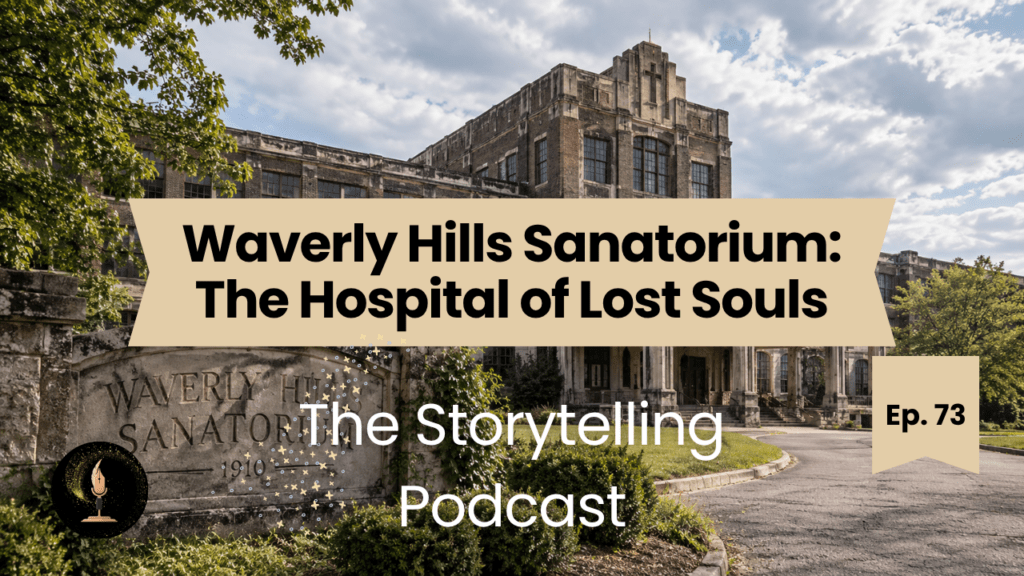
High above Louisville, Kentucky, stands a building whose history has become almost inseparable from its legends.
Waverly Hills Sanatorium was built during the height of the tuberculosis epidemic in America. Long before paranormal investigators carried cameras and recorders through its corridors, the building was filled with patients hoping for something much simpler: another chance at life.
Today, Waverly Hills is famous around the world as a supposedly haunted location.
Visitors come looking for ghosts. Paranormal investigators search for unexplained sounds and voices. Television programmes have spent entire episodes investigating its corridors.
But beneath all those stories is something much more important.
The real history of Waverly Hills.
Historical Background
Tuberculosis was once one of the world’s most feared diseases. Before effective antibiotic treatment, patients could spend months or years isolated from their families while doctors attempted to slow the progression of the illness.
Louisville and Jefferson County were badly affected by tuberculosis in the early twentieth century.
Waverly Hills opened in 1910 as a relatively small facility designed to care for tuberculosis patients. The medical philosophy of the time emphasised rest, nutrition, sunlight and fresh air.
Patients were often encouraged to spend long periods outside on open-air porches, even in uncomfortable weather.
As the number of tuberculosis cases increased, the original facilities became inadequate.
A much larger building was eventually constructed. The five-storey structure that dominates the site today opened in 1926 and could accommodate more than 400 patients.
For the people who entered its doors, Waverly Hills was not a haunted attraction.
It was a hospital.
The Main Story
Imagine arriving at Waverly Hills as a tuberculosis patient.
You may have travelled there because doctors believed the sanatorium offered your best chance of recovery.
But you would also have understood the seriousness of your illness.
Tuberculosis was contagious, and isolation could mean months or years away from home.
Some patients recovered, while others did not.
The famous claim that 63,000 people died at Waverly Hills is repeated constantly in paranormal culture, but the number should be treated with caution. Historical researchers have not found documentation supporting the claim as a reliable death total. Kentucky Historic Institutions has instead worked to document recorded patient deaths, maintaining an index of deaths at Waverly Hills between 1911 and 1960.
The distinction matters.
Waverly Hills does not need an inflated death toll to be historically significant.
The suffering that occurred there was real.
The Body Chute
One of Waverly Hills’ most famous features is the long tunnel beneath the hospital.
Today, it is usually called the Body Chute.
The name immediately suggests something sinister, but the tunnel had a practical purpose.
It was originally associated with the movement of supplies and materials around the steep hillside. It was later used to move deceased patients away from the main areas of the hospital, helping keep the reality of death away from other patients whenever possible.
Today, visitors describe hearing footsteps, whispers and strange echoes inside the tunnel.
There is also a simple explanation for some of those sounds.
A long concrete tunnel is an extraordinary acoustic environment. Footsteps, dripping water and distant noises can bounce through the structure and create sounds whose apparent location is difficult to judge.
That doesn’t tell us what every visitor experienced.
But it reminds us that an unexplained sound isn’t automatically evidence of a ghost.
Room 502
Then there is Room 502.
The room has become one of Waverly Hills’ most famous locations because of a story involving a nurse who allegedly died there.
The most familiar version claims that a young nurse became pregnant out of wedlock, feared social disgrace and eventually hanged herself in the room.
Another story involves a second nurse allegedly jumping from the building.
The problem is that these stories are difficult to establish as documented history.
The legends have been repeated for decades, but the evidence for the familiar versions of the story is much weaker than the certainty with which they are sometimes presented.
And that makes Room 502 particularly interesting.
It sits directly on the boundary between history and folklore.
Watch the Episode
Watch the full episode below
FAQs
Is Waverly Hills Sanatorium really haunted?
There is no scientific evidence establishing that Waverly Hills is haunted. Many visitors and paranormal investigators have reported unexplained experiences, but these remain matters of personal experience and interpretation.
Did 63,000 people die at Waverly Hills?
The often-repeated figure of 63,000 deaths is not supported by surviving documentation as a reliable total. Recorded death indexes and historical research provide a more cautious picture.
What was the Body Chute used for?
The tunnel served practical functions connected with moving supplies and materials and was later used to move deceased patients away from the main areas of the hospital.
What happened to Waverly Hills after it closed?
After the tuberculosis hospital closed in 1961, the building reopened as Woodhaven Geriatric Center in 1962. It eventually closed in 1982.
Is Room 502’s story true?
The famous story about the nurse in Room 502 is part of Waverly Hills folklore, but the commonly repeated details are not firmly established by surviving historical evidence.
🎥 YouTube Visual Episode: https://youtu.be/95zUu3LqXI0
🎧 Available on all podcast platforms.
📩 Story submissions:
thestorytellingpodcast80@gmail.com
🌐 Buzzsprout:
https://thestorytellingpodcast.buzzsprout.com
❤️ Support the podcast:
https://www.buzzsprout.com/2443276/support
🌍 Website:
https://alejandraslife.com/
📱 Follow us:
@thestorytellingpodcastofficial
@AleLifeOfficial
▶️ YouTube:
https://www.youtube.com/@AlejandrasLife