
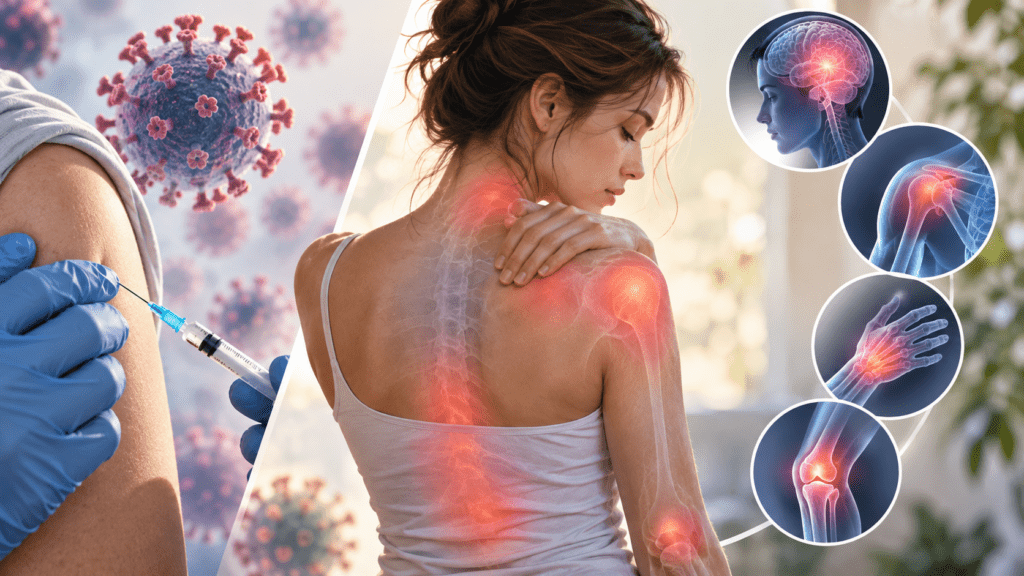
COVID-19 vaccination has raised questions for people living with chronic pain and autoimmune conditions. Some people have reported increased pain, fatigue or other symptoms after receiving a vaccine, while studies have produced mixed results on whether vaccination can trigger a flare of an existing condition.
Fibromyalgia is often part of this conversation, although it is important to point out that fibromyalgia is not an autoimmune disease. It is a chronic pain condition associated with widespread pain, fatigue, sleep problems and cognitive symptoms. Autoimmune diseases, including conditions such as rheumatoid arthritis and lupus, involve the immune system attacking the body’s own tissues.
So, what happens when someone with one of these conditions receives a COVID-19 vaccine?
Fibromyalgia And COVID-19 Vaccination
There is relatively little research specifically looking at people who already have fibromyalgia and then receive a COVID-19 vaccine.
One of the studies that has attracted attention was published in Pain Reports in 2023. Researchers examined 15 people who developed widespread pain and generalised sensory symptoms after COVID-19 vaccination.
All 15 patients reported widespread pain, and 11 met the diagnostic criteria for fibromyalgia.
The symptoms appeared between one and 30 days after vaccination and included fatigue, unrefreshing sleep, cognitive problems, tingling, burning pain and sensations described as electric shocks.
The researchers also looked for evidence of small-fibre neuropathy, which can cause pain and abnormal sensations. Skin biopsies were normal in all 15 patients. Nine patients who reported orthostatic intolerance underwent cardiovascular autonomic testing, which was also normal.
Five patients had abnormalities in quantitative sensory testing.
The researchers described the findings as more consistent with a fibromyalgia-like syndrome than demonstrable small-fibre nerve damage. They also stressed that the study involved only 15 people and did not include a control group.
Can A Vaccine Trigger A Fibromyalgia Flare?
This is harder to answer.
The 2023 study did not look at people with established fibromyalgia to see whether their symptoms became worse after vaccination. It looked at people who developed widespread pain and other symptoms following vaccination.
As a result, it cannot tell us how often vaccination triggers a flare in someone who already has fibromyalgia.
There is also no large study showing that COVID-19 vaccination generally causes permanent worsening of established fibromyalgia.
That does not mean that an individual with fibromyalgia cannot feel worse after vaccination. A temporary increase in pain, fatigue, headaches or sleep problems may occur, but the reason for that change cannot be determined from timing alone.
What Studies Have Found In Autoimmune Diseases
There is more research on people with autoimmune and inflammatory rheumatic diseases.
A 2024 study using the EULAR Coronavirus Vaccine Registry followed 7,336 people with inflammatory rheumatic and musculoskeletal diseases.
Among them, 272 people, or 3.7%, reported a disease flare after vaccination. In 121 cases, representing 1.6% of the entire group, the flare led to a new medication being started or an existing medication dose being increased.
Among the 272 people who reported a flare, arthritis was the most common problem, accounting for 49.6% of flares. Polyarthralgia accounted for 37.9%, while increased fatigue accounted for 12.1%.
The average time between vaccination and the reported flare was 7.2 days.
People who had active disease at the time of vaccination were more likely to report a flare. Stopping or reducing antirheumatic medication around vaccination was also associated with a higher likelihood of a flare.
These numbers apply to people with inflammatory rheumatic and musculoskeletal diseases. They do not represent people with fibromyalgia.
Another Study Found No Increased Flare Risk
A separate study reached a different conclusion.
Researchers used a self-controlled case-series design to examine 3,554 people with autoimmune rheumatic diseases. Rather than comparing different groups of people, the study compared periods following vaccination with other periods in the same individuals.
For all vaccine doses combined, the adjusted incidence rate ratio for an autoimmune rheumatic disease flare during the 21 days after vaccination was 0.89, with a 95% confidence interval of 0.80 to 0.98.
For the first vaccine dose, the adjusted incidence rate ratio was 0.76, with a 95% confidence interval of 0.66 to 0.89. No significant association was found following the second or third doses.
The researchers concluded that COVID-19 vaccination was not associated with an increased risk of autoimmune rheumatic disease flares.
Patient Surveys Have Reported Flares Too
Patient surveys tell a somewhat different story.
The COVID-19 Global Rheumatology Alliance surveyed 5,619 adults with systemic rheumatic diseases. In that study, 4.9% reported a flare after vaccination that required a change in treatment.
The researchers also found differences between individual diseases, with some conditions showing higher odds of a treatment-changing flare than others.
Because this study relied on patient-reported information collected through an online survey, its results are not directly comparable with studies based on medical records or physician-reported disease activity.
Which Symptoms Have Been Reported?
Fatigue, muscle pain and joint pain are among the symptoms reported following COVID-19 vaccination in people with rheumatic and autoimmune diseases.
A multicentre survey from southern India looked at vaccination in people with autoimmune rheumatic diseases. Body pain or myalgia was reported by 25.37% of participants, fever by 19.95%, injection-site pain by 18.56% and self-limiting joint pain lasting one to three days by 9.04%.
The researchers also recorded worsening of an existing rheumatic disease in 2.47% of participants. A minor flare was reported by 1.54%, while fewer than 1% experienced a flare requiring an increase in medication.
No major flare requiring hospitalisation was reported.
The study involved a specific population in southern India, so these figures cannot be applied to everyone with an autoimmune rheumatic disease.
What About Symptoms That Do Not Go Away?
Most expected vaccine reactions are short-lived. Persistent symptoms are a different issue.
The 2023 Pain Reports study involved people whose widespread pain and sensory symptoms continued after vaccination. Eleven of the 15 participants met fibromyalgia diagnostic criteria.
However, the study was very small and had no control group. It cannot tell us how common persistent symptoms are after vaccination or whether vaccination was responsible for them.
This is one area where larger studies would be useful, particularly studies that follow people with existing fibromyalgia before and after vaccination.
COVID-19 Infection May Also Play A Role
COVID-19 itself can cause prolonged fatigue, widespread pain, sleep problems and cognitive symptoms. These can overlap with symptoms associated with fibromyalgia.
This makes it difficult to look at vaccination in isolation.
A 2025 study examined new-onset fibromyalgia among people who had already survived COVID-19. The researchers studied 181,016 COVID-19 survivors, including 90,508 vaccinated people and 90,508 unvaccinated people.
There were 242 new fibromyalgia diagnoses in the vaccinated group and 289 in the unvaccinated group.
The reported hazard ratio was 0.843, with a 95% confidence interval of 0.710 to 0.999.
In this study, vaccination was associated with a lower risk of newly diagnosed fibromyalgia among COVID-19 survivors.
However, this was a study of new-onset fibromyalgia. It did not examine whether vaccination made existing fibromyalgia worse.
What We Know About Fibromyalgia And COVID-19 Vaccines
The research does not give us a clear answer for people who already have fibromyalgia.
A small 2023 study documented widespread pain and fibromyalgia syndrome in people who developed persistent symptoms after vaccination. Meanwhile, larger studies involving autoimmune and inflammatory rheumatic diseases have produced different results, with some documenting post-vaccination flares and another finding no increased flare risk.
The numbers also vary depending on how researchers define a flare and whether information comes from patients, doctors or medical records.
For someone with existing fibromyalgia, a vaccine may be followed by increased pain, fatigue or other symptoms. What the current research cannot establish is how often this represents a genuine fibromyalgia flare, how long it lasts or whether vaccination is responsible for the change.
The evidence also does not show that COVID-19 vaccination generally causes fibromyalgia or permanently worsens the condition.
At the same time, persistent or significant symptoms should not simply be dismissed as a normal vaccine reaction. A doctor can look at the timing of symptoms, previous COVID-19 infection, existing conditions, medications and other possible causes.
Sources And Further Reading
- COVID-19 Vaccination And Fibromyalgia: Pain Associated With COVID-19 Vaccination Is Unrelated To Skin Biopsy Abnormalities — Pain Reports, 2023.
- Factors Associated With Disease Flare Following SARS-CoV-2 Vaccination In People With Inflammatory Rheumatic And Musculoskeletal Diseases — EULAR COVAX Registry, 2024.
- Is Vaccination Against COVID-19 Associated With Autoimmune Rheumatic Disease Flare? — Self-controlled case-series study.
- Baseline Factors Associated With Self-Reported Disease Flares Following COVID-19 Vaccination — COVID-19 Global Rheumatology Alliance vaccine survey.
- COVID-19 Vaccination In Autoimmune Rheumatic Diseases — Multicentre survey from southern India.
- COVID-19 Vaccination And New-Onset Fibromyalgia Risk Among COVID-19 Survivors — 2025 cohort study.
This article is for general information and does not replace individual medical advice.