

John Lewis has launched its 2026 Christmas advert, Gloria and Pickles.
Created by Saatchi & Saatchi and directed by Lucy Forbes.
The campaign stars Dame Kristin Scott Thomas as Gloria, with Paul Whitehouse voicing Pickles, her childhood toy dog. Its soundtrack features Sam Fender covering The Rolling Stones’ You Can’t Always Get What You Want.
Released on 3 November 2026, the three-minute film carries the message “Don’t give up on giving”, placing thoughtful gift-giving and family relationships at the centre of John Lewis’s Christmas storytelling.
It is the retailer’s 20th modern Christmas campaign, continuing a recognisable advertising tradition while introducing a new family story and a different perspective on the pressures of choosing the right present.
Creative Concept And Brand Heritage
The story follows Gloria as she prepares to welcome her daughter, son-in-law and grandchildren, Freddie and Maggie, for Christmas.
When the children show little interest in the toys she has brought down from the attic, Gloria becomes uncertain about what to give them. She considers putting money inside their Christmas cards, believing that cash is a safer option than choosing something they might not like. Her childhood pull-along dog, Pickles, unexpectedly comes to life and challenges that decision.
Pickles takes Gloria on an adventure through London and towards John Lewis, where she finds inspiration for a more personal present. Instead of buying a conventional gift, Gloria transforms her study into a colourful playroom, which she names the “Gran Cave”. On Christmas morning, she gives her grandchildren a key to the room, creating a shared experience rather than simply handing them an object.
The creative idea works because the problem is immediately recognisable: choosing a present can be difficult when the recipient’s interests are unclear. Gloria’s decision to give cash is practical, but the campaign argues that a thoughtful gift can communicate something money alone cannot.
There is a clear connection with John Lewis’s previous Christmas campaigns, but the comparison is relevant because these are adverts for the same brand. The Gifting Hour in 2024 explored the thought and effort involved in choosing a present, while Where Love Lives in 2025 used music and family memories to tell a story about connection.
Why John Lewis Is Encouraging Shoppers To Give More Thoughtfully
For John Lewis, the campaign is about more than promoting Christmas products. It addresses a consumer behaviour that retailers encounter every year: people want to give meaningful presents but are not always confident about what to buy.
The advert turns that uncertainty into a story and positions John Lewis as a place where shoppers can find inspiration across home, fashion and lifestyle categories.
The central message gives the campaign a clear commercial role: encourage people to think beyond generic gifts and consider more personal choices. Its distribution across television, broadcaster video-on-demand, streaming, connected TV and social platforms extends the campaign beyond its television premiere and gives the film multiple opportunities to reach consumers.
OnePulse surveyed 500 UK adults on 3 November 2026, the day the advert launched. The findings provide an early indication of audience response and offer useful context for the campaign’s central insight.
OnePulse Audience Survey: John Lewis Christmas Advert 2026
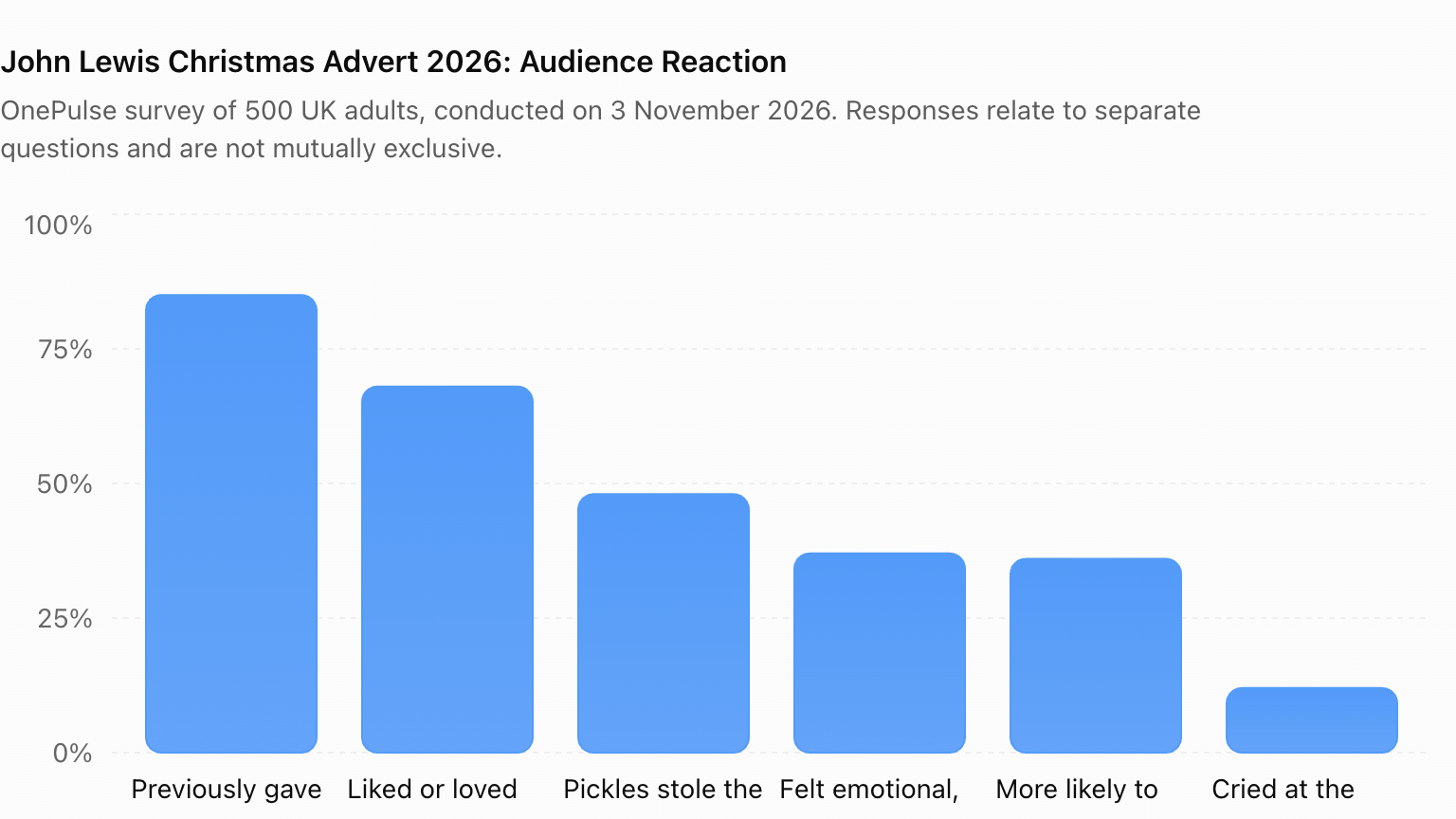
The survey found that 68% of respondents liked or loved the advert, with an average rating of 3.8 out of 5.
- Pickles was identified as the character who stole the show by 48% of respondents
- The gifting insight was particularly relevant: 85% said they had previously given cash as a Christmas present because they did not know what else to buy
- In addition, 36% said the advert made them more likely to shop at John Lewis that Christmas
- A further 37% said they felt emotional without crying
- 12% said they cried.
These findings suggest that the campaign’s storyline connected with a recognisable gifting problem and that its central character made an impression. However, stated purchase intention is not the same as actual purchasing behaviour, and launch-day survey responses cannot establish the campaign’s effect on sales or long-term brand performance.
For CMOs and retail marketers, three points stand out:
- Start with a recognisable consumer problem: The uncertainty around choosing gifts gives the campaign a clear and relatable foundation.
- Make the brand part of the solution: John Lewis is integrated into Gloria’s journey, rather than appearing only as a product-placement destination.
- Build an emotional story around a commercial objective: The advert promotes thoughtful gifting while supporting the retailer’s wider product categories.
The campaign’s effectiveness should ultimately be assessed using further evidence, including sales performance, customer behaviour, brand consideration and the impact of the wider Christmas marketing activity.
POV: Why Gloria And Pickles Make An Effective Christmas Advert
The strongest part of Gloria and Pickles is its central idea: a good present should show that someone has been considered.
The campaign does not rely entirely on nostalgia or an elaborate fantasy sequence. It gives Gloria a recognisable problem, allows Pickles to challenge her thinking and then delivers a resolution that feels connected to the relationship between the characters.
The decision to make a grandmother the main character also gives the advert a different perspective from many Christmas campaigns built around children, parents or romantic relationships.
In my point of view, John Lewis has delivered a campaign that understands the difference between selling a product and selling the meaning attached to it. That is what makes Gloria and Pickles a fitting addition to the retailer’s Christmas advertising history.
Campaign Credits:
- Brand: John Lewis
- Creative agency: Saatchi & Saatchi
- Director: Lucy Forbes
- Production company: Smuggler
- Industry coverage: The Drum
Image credit: John Lewis and the Drum.