

Artificial intelligence has become part of the consumer experience, often before people even realise they are interacting with it. From personalised product recommendations and AI-powered search results to virtual shopping assistants, technology is influencing how people discover brands, evaluate products and decide where to spend their money. What once required hours of browsing, comparing websites and reading reviews can now happen through a single conversation with an AI assistant.
However, the biggest change is not simply that consumers are using more technology. It is that their expectations are evolving.
People increasingly want faster answers, relevant recommendations and shopping experiences that understand their needs without making them work through endless options. For businesses, this creates a different kind of challenge: attracting attention is no longer enough when artificial intelligence is also influencing which brands consumers consider in the first place.
AI Is Changing How Consumers Discover Brands
Traditional online shopping often begins with a search engine, a retailer’s website or a social media recommendation. Consumers browse different options, compare prices and eventually narrow down their choices. AI is changing this journey by introducing a more conversational approach to product discovery.
Instead of searching for several individual products, consumers can ask an AI assistant to recommend the best laptop for working remotely, compare skincare products for a particular concern or find a hotel that meets specific travel requirements. The technology can then organise information, compare alternatives and present recommendations based on the request.
Research published by NielsenIQ in May 2026 found that 42% of consumers had used at least one AI tool for shopping during the previous month. Its research also identified product recommendations and AI shopping assistants as emerging parts of the purchasing journey. Meanwhile, a later report from NIQ and World Data Lab highlighted that nearly three-quarters of shoppers were using AI for product discovery.
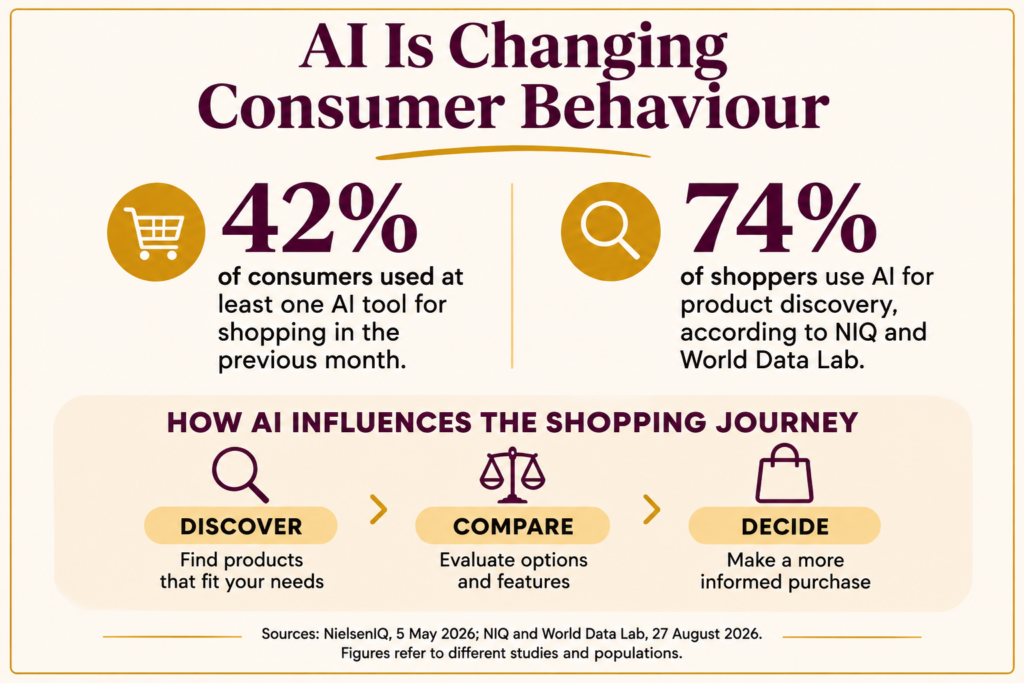
This changes the way brands compete for visibility. A business might have a strong website, established reputation and an extensive advertising strategy, but consumers may increasingly encounter its products through an AI-generated recommendation rather than directly through its marketing channels.
For brands, being discoverable therefore involves more than appearing in traditional search results. Product information needs to be accurate, detailed and consistent, while websites must clearly communicate what a business offers, who its products are intended for and what makes them different.
Personalisation Is Raising Consumer Expectations
Personalisation has been part of digital marketing for years, particularly through recommendation algorithms, targeted advertising and personalised email campaigns. AI is taking these experiences further by making recommendations more contextual and responsive to individual requests.
Consumers can receive suggestions based on their preferences, previous interactions, budgets and shopping requirements. An AI-powered assistant can also help someone compare products according to specific criteria rather than simply presenting a list of popular options.
This creates opportunities for businesses to make the customer experience more relevant. Retailers can use AI to improve product recommendations, provide faster customer support and identify patterns in consumer preferences. Travel companies can offer more tailored itineraries, while fashion retailers can help shoppers explore products according to their personal style.
Nevertheless, personalisation comes with an important condition: consumers need to feel comfortable with how their information is being used. Recommendations that appear excessively intrusive, inaccurate or unrelated to someone’s interests can undermine confidence rather than strengthen customer relationships.
Transparency is an important part of the experience. Consumers should understand how their data is collected and used, while brands need to make sure that personalisation genuinely improves the service they provide.
Consumers Still Want Control Over Purchasing Decisions
Although AI is becoming increasingly influential, consumers are not necessarily ready to hand over every purchasing decision to technology.
Research from Gartner published in May 2026 found that only 11% of surveyed US consumers were willing to let AI make purchasing decisions, even in relatively low-risk product categories. However, 31% were willing to let AI narrow down household product choices, demonstrating a stronger appetite for assistance than complete automation.
Consumers may welcome an assistant that compares prices, identifies suitable products and explains the differences between alternatives, but they still want to decide which product deserves their money.
Trust is central to this relationship. If an AI assistant provides inaccurate product specifications, outdated prices or recommendations that do not match a consumer’s requirements, the experience can quickly become frustrating. Gartner also reported that 54% of consumers who had used AI while shopping for a recent purchase needed to double-check all the information provided.
For brands, this means that technology cannot compensate for poor product information or an unreliable customer experience. Businesses still need accurate descriptions, transparent pricing, dependable customer service and clear purchasing policies.
AI may increasingly influence which products enter a consumer’s consideration, but the quality of the product and the experience surrounding it will continue to determine whether that recommendation leads to a lasting customer relationship.
The Future of Consumer Behaviour Is About Trust
AI is changing the relationship between consumers and brands by influencing discovery, comparison, personalisation and purchasing decisions. The shift is already visible, but it does not mean that human judgement is disappearing from the shopping experience.
Consumers want convenience, relevant information and recommendations that save time. They also want transparency, accuracy and the freedom to make their own decisions. Businesses that understand this balance will be better positioned to adapt as AI becomes more deeply integrated into everyday consumer experiences.
For brands, the next stage of digital competition will involve earning visibility not only in traditional search engines and social platforms, but also in the AI-powered environments where consumers increasingly research their options.
Technology may influence what people see, but trust remains essential to why they choose a brand.
Photo by Kindel Media: https://www.pexels.com/photo/black-miniature-robot-toy-on-wooden-surface-8566449/