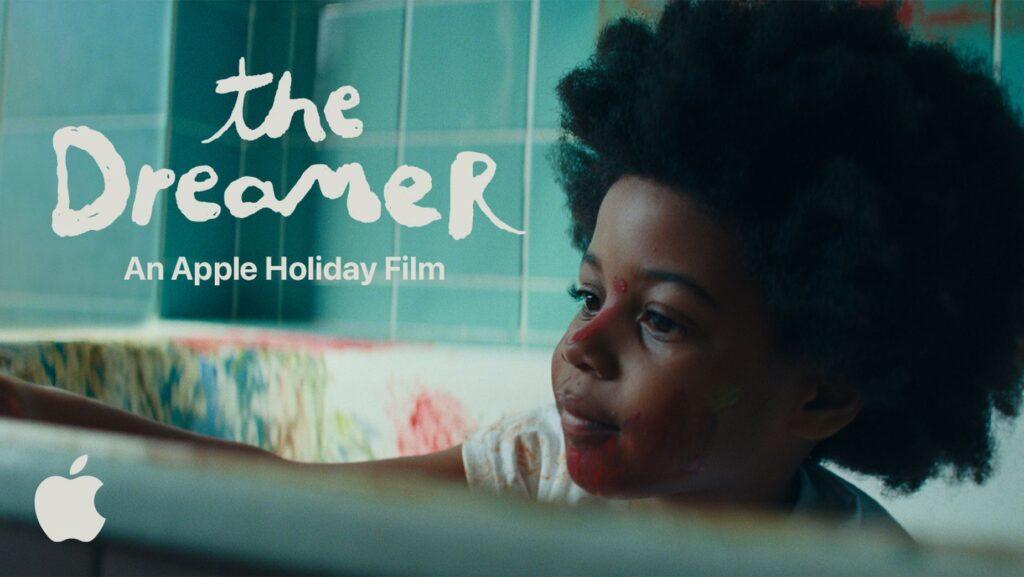
Apple has placed creative confidence at the centre of its 2026 Christmas campaign, The Dreamer, a nearly four-minute holiday film created by TBWA\Media Arts Lab, produced by PRETTYBIRD and De La Revolución, and directed by Melina Matsoukas.
Featuring cinematography by Bradford Young and original artwork by Hebru Brantley, the film introduces the MacBook Neo as a Christmas gift that helps a young artist rediscover his creativity. Released on 12 November, the campaign closes with a simple message: “Show someone you believe in them.”
The timing offers an interesting creative contrast with the growing volume of AI-generated advertising. Apple places a named artist and his original creative process at the centre of the campaign. This is not presented as an explicit response to AI, but it gives the film a clear emphasis on human imagination, artistic development and the people behind the work.
Apple Uses a Christmas Story to Reconnect a Young Artist with Creativity
The Dreamer follows a boy whose childhood is filled with drawing, painting and an unusually vivid imagination. As he grows older, discouraging experiences and the pressure of growing up gradually push his creative ambitions into the background. He continues to draw privately, but becomes reluctant to share his work.
His parents, however, never stop seeing his artistic potential. On Christmas Day, they give him a MacBook Neo, a gesture that represents more than a new piece of technology. It is a reminder that they believe in him and want him to keep creating. With the laptop, he begins developing a new illustrated character, bringing his ideas into the digital world.
The artwork is central to the film rather than simply an aesthetic addition. Brantley created every illustration, from the protagonist’s early drawings to the final animated character. His work follows the boy’s development and gives the audience a visual understanding of how his relationship with creativity changes over time. Brantley also developed the final character using MacBook Neo, combining analogue and digital processes.
The campaign has a personal connection for its collaborators. Brantley explained that his own mother recognised his artistic potential before he did:
“My mother saw the artist in me before I could see it in myself, and her belief gave me the confidence to explore that.”
Director Melina Matsoukas also described the film as an opportunity to encourage creative expression and support artists:
“My goal with work is to create pieces that move people and create change in the world.”
The film is accompanied by ‘Give Me a Dream’ by Strawberry Guy, with music helping carry the story without relying on conventional dialogue. Apple has also released Creating the Art, a behind-the-scenes feature exploring Brantley’s creative process and the development of the illustrations.
How Apple Connects Technology with Creative Confidence
Apple’s approach is built around making the MacBook Neo part of a personal story rather than presenting it through a conventional product demonstration. The laptop has a practical role in the film, allowing the protagonist to develop his artwork, but its emotional significance comes from the people who give it to him.
This distinction is important. Apple does not suggest that buying a computer automatically makes someone creative. The protagonist already has the imagination and artistic ability. The MacBook Neo gives him another way to explore those skills, while his parents provide the encouragement that helps him return to them.
Three marketing decisions stand out:
- Emotional product positioning: The MacBook Neo represents parental belief and encouragement, giving the product a role beyond its technical features.
- Original creative collaboration: Hebru Brantley’s illustrations are integral to the story, making the artwork part of the narrative rather than a decorative campaign element.
- Human-centred brand storytelling: The campaign focuses on creativity, self-expression and personal relationships, reinforcing Apple’s association with tools that help people bring ideas to life.
The audience response has been encouraging. On 23 November, the film had passed 15.1 million views across YouTube, social platforms and fan posts. The publication also reported that it delivered Apple’s strongest first-24-hour organic YouTube performance for a holiday film.
These figures indicate early audience attention, but they are not evidence of MacBook Neo sales growth or advertising return. Apple has not disclosed campaign-specific conversion, sales uplift or ROI figures.
POV: Apple Makes Belief the Most Meaningful Christmas Gift
Apple’s The Dreamer takes a different approach to the Christmas campaigns we’ve covered this season. Apple makes the relationship between a parent and child the foundation of its product story.
What makes Apple’s execution particularly effective is that it does not suggest technology creates talent. The MacBook Neo becomes a symbol of encouragement, while Hebru Brantley’s original illustrations give the film an authentic creative identity. The message is not simply about giving someone a laptop. It is about recognising their potential and helping them find the confidence to pursue it. In a Christmas advertising season full of familiar characters, festive food and nostalgic entertainment, Apple chooses to make belief the gift that matters most.
While M&S’s Christmas campaign builds its story around the emotional familiarity of home and festive traditions, Lidl combines entertainment and product positioning through Nico the Nutcracker and its nostalgic Lidl Christmas Everybody music video. Waitrose, meanwhile, has brought back Keira Knightley and Joe Wilkinson for a six-minute romantic comedy, using the relationship between its characters and a homemade beef Wellington to keep festive food at the centre of the story.
Disney’s The Invisible Horse offers another interesting comparison. Like Apple, it chooses an original character rather than relying on an established franchise, using imagination and emotional storytelling to create a connection with audiences. However, where Disney focuses on rediscovering childhood wonder and bringing its wider entertainment ecosystem together.
Campaign Credits
- Brand: Apple
- Campaign: The Dreamer
- Market: United States, with international distribution
- Launch date: 12 November 2026
- Agency: TBWA\Media Arts Lab
- Production companies: PRETTYBIRD and De La Revolución
- Director: Melina Matsoukas
- Director of Photography: Bradford Young
- Artist collaborator: Hebru Brantley
- Editing: Final Cut
- Editor: Jeff Buchanan
- Post-production: Pariah
- Colour: Color Collective
- Sound: Lime Studios
- Music: “Give Me a Dream” by Strawberry Guy
- Featured product: MacBook Neo
Images credited to Apple