
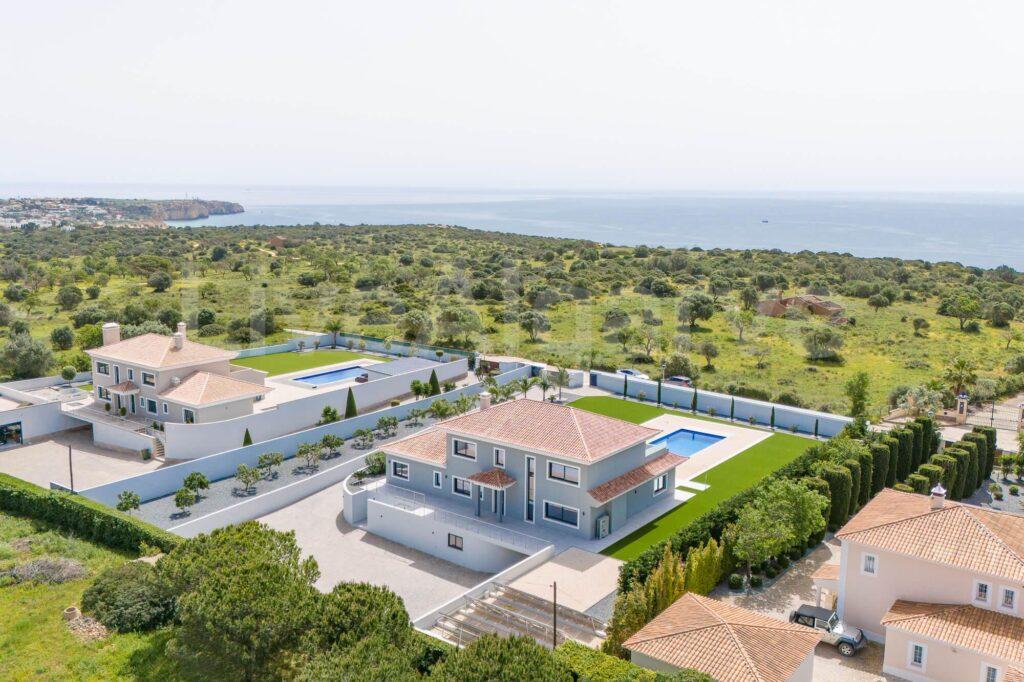
The idea that investing in a luxury holiday home is primarily a financial decision no longer reflects how high-net-worth individuals approach the market. In recent years, the logic has shifted meaningfully, with factors such as quality of life, security, and ease of use becoming central to the decision-making process. This shift helps explain why Europe has emerged as the global leader in this segment.
A new briefing by Global Citizen Solutions (GCS) reinforces this trend by analysing 20 international markets and identifying a consistent pattern. The most attractive destinations are not necessarily those with the highest standalone returns, but those that balance three essential dimensions: real estate performance, lifestyle, and accessibility. It is precisely this balance that sets Europe apart in a structural way.
The Growing Weight of Lifestyle in Investment Decisions
The briefing, available at https://www.globalcitizensolutions.com/briefing/best-places-to-own-a-holiday-home-as-a-hnwi/, shows that seven of the top ten destinations for luxury holiday homes are located in Europe. A single factor does not drive this dominance, but by a combination that is difficult to replicate in other regions.
Favourable climate, high-quality infrastructure, political stability, and relatively accessible frameworks for foreign buyers create a particularly compelling environment. However, the real differentiator lies in how these factors enhance the experience of owning and using the property.
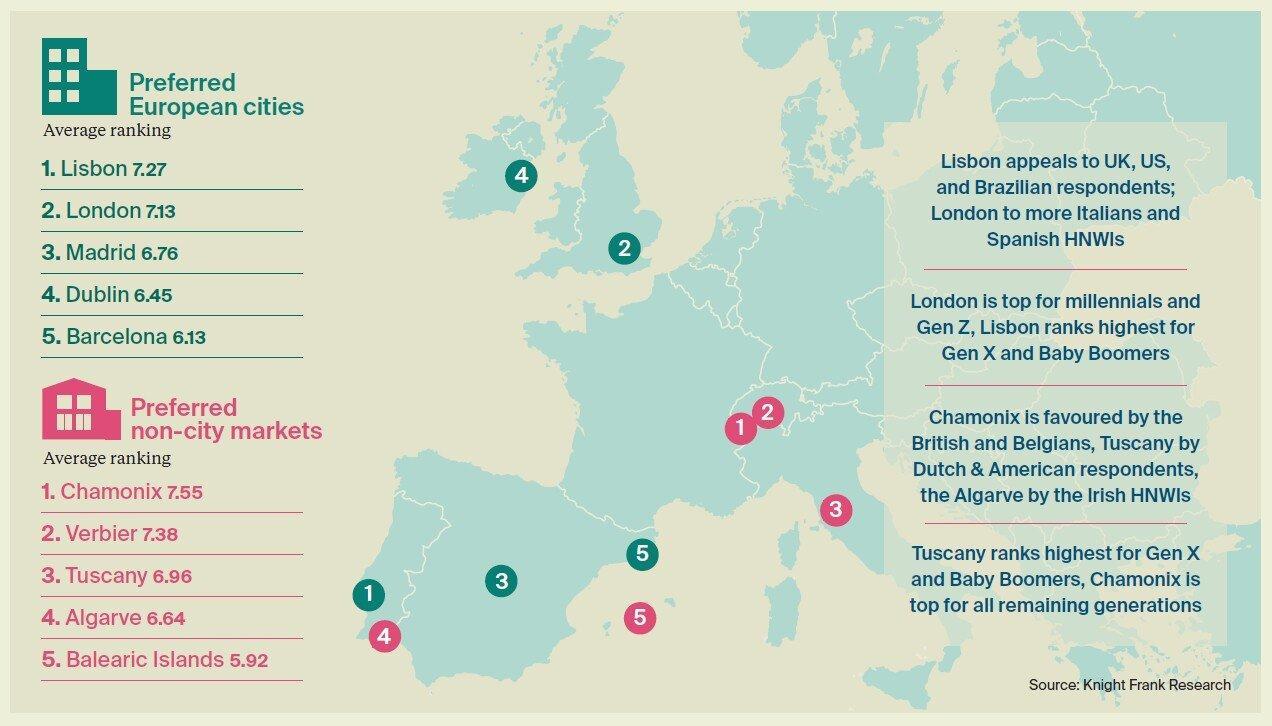
Spain and Portugal clearly illustrate this dynamic. Spain stands out for balancing strong property appreciation with a high quality of life, while Portugal records the highest growth in median bank valuation, with a 17.7% increase up to October 2025. This performance is not incidental. Regions such as the Algarve and Comporta combine safety, accessibility, and strong tourism demand, supporting both personal use and rental income potential.
What emerges from this analysis is a shift in priorities. Rather than buying purely for capital appreciation, investors are choosing destinations where they can genuinely spend time and integrate the property into their lifestyle throughout the year. This consistent use tends to make the investment more resilient, even during periods of economic uncertainty.
Two Distinct Models Within Europe
Despite Europe’s overall leadership, the study highlights a clear division between two types of markets within the continent. This distinction helps explain the different profiles of buyers and their motivations.
Southern European countries such as Spain, Portugal, France, and Italy attract buyers who are primarily lifestyle-driven. These investors value frequent use, mild climate, and cultural integration. Property appreciation remains relevant, but it is often a by-product of a broader decision centred on experience.
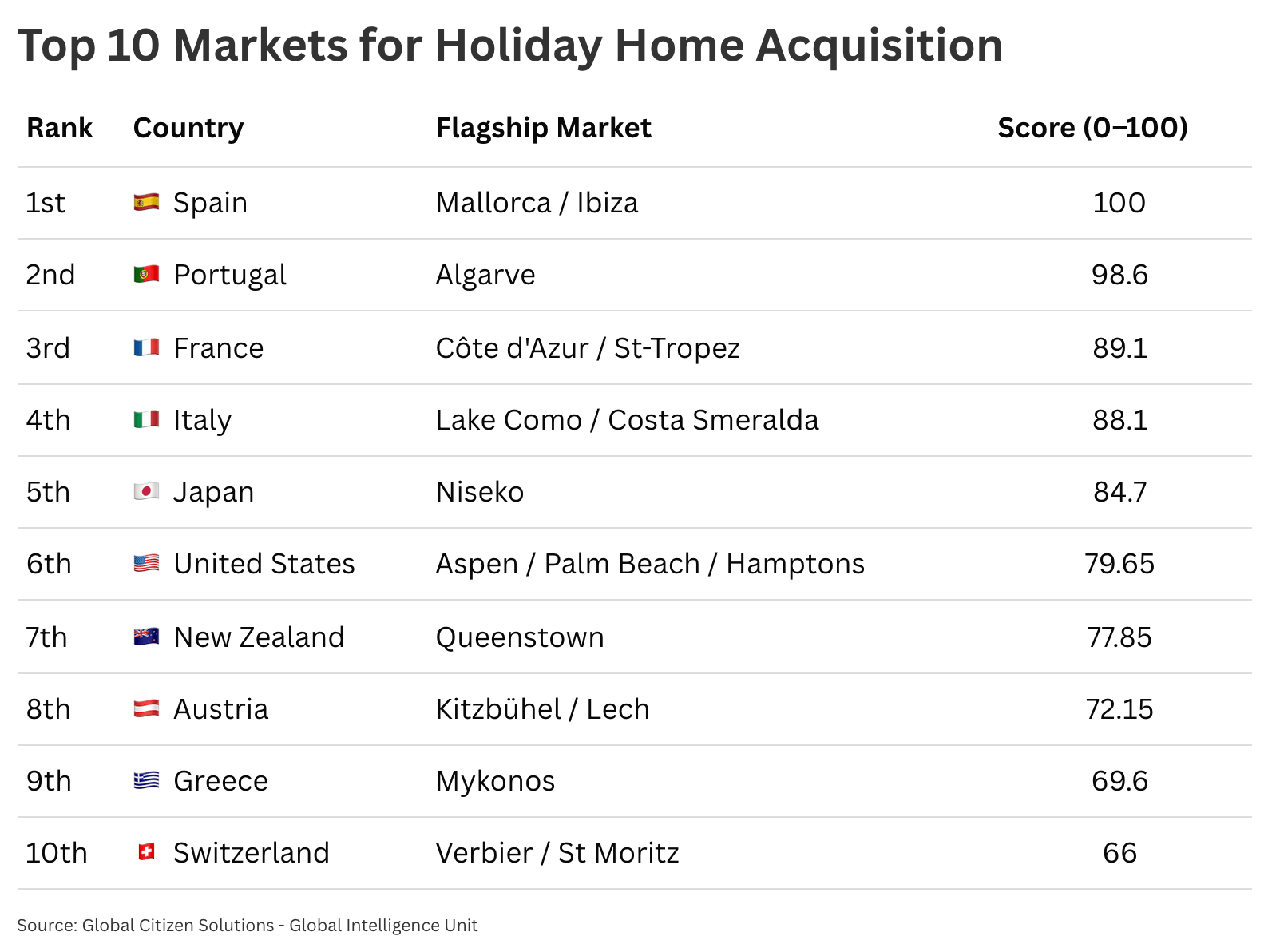
In contrast, Alpine markets such as Austria and Switzerland follow a different logic. Here, the focus is on stability and scarcity. Limited supply, combined with very high levels of security, creates an environment where properties are often held across generations. In these cases, a holiday home functions more as a store of value than as a frequently used asset.
This contrast highlights an essential point: there is no single model for investing in luxury holiday homes. Instead, strategies tend to align with specific objectives, whether that is income generation, capital preservation, or lifestyle enhancement.
Global Diversification Beyond Europe
Although Europe dominates the ranking, the briefing also underlines the role of other markets in building diversified portfolios. Destinations such as Niseko in Japan and Queenstown in New Zealand emerge as strategic alternatives, offering stability, security and growing international demand.
These markets do not directly compete with Europe in terms of traditional lifestyle appeal, but they add an important layer to global investment strategies. They act as diversification tools, helping to mitigate geographic concentration risk.
The United States stands out for its air connectivity, making luxury properties across the country more accessible. Greece, meanwhile, gains attention for its climate, recording the highest number of sunshine hours among the markets analysed.
What unites these destinations is their ability to serve specific roles within a broader portfolio strategy. Rather than replacing Europe, they complement it, reinforcing the idea that investing in holiday homes has become increasingly multidimensional.
A New Paradigm for Luxury Holiday Homes
The key contribution of this briefing lies not only in its ranking of destinations but in how it reframes the concept of value in this type of investment. By placing greater emphasis on lifestyle than on traditional real estate fundamentals, the analysis more accurately reflects how high-net-worth individuals actually engage with their properties.
A holiday home is no longer viewed solely as a financial asset, but as an extension of the owner’s way of living. This shift is reshaping not only how markets are evaluated, but also how they evolve.
In a global context defined by uncertainty and increased mobility, the ability to live well across multiple locations has become an asset in its own right. It is precisely at this intersection that Europe consolidates its position, not just as an investment destination, but as a benchmark for lifestyle-driven luxury real estate.
Image: https://livealgarve.com/